*
Sages of old didn’t try to escape the world.
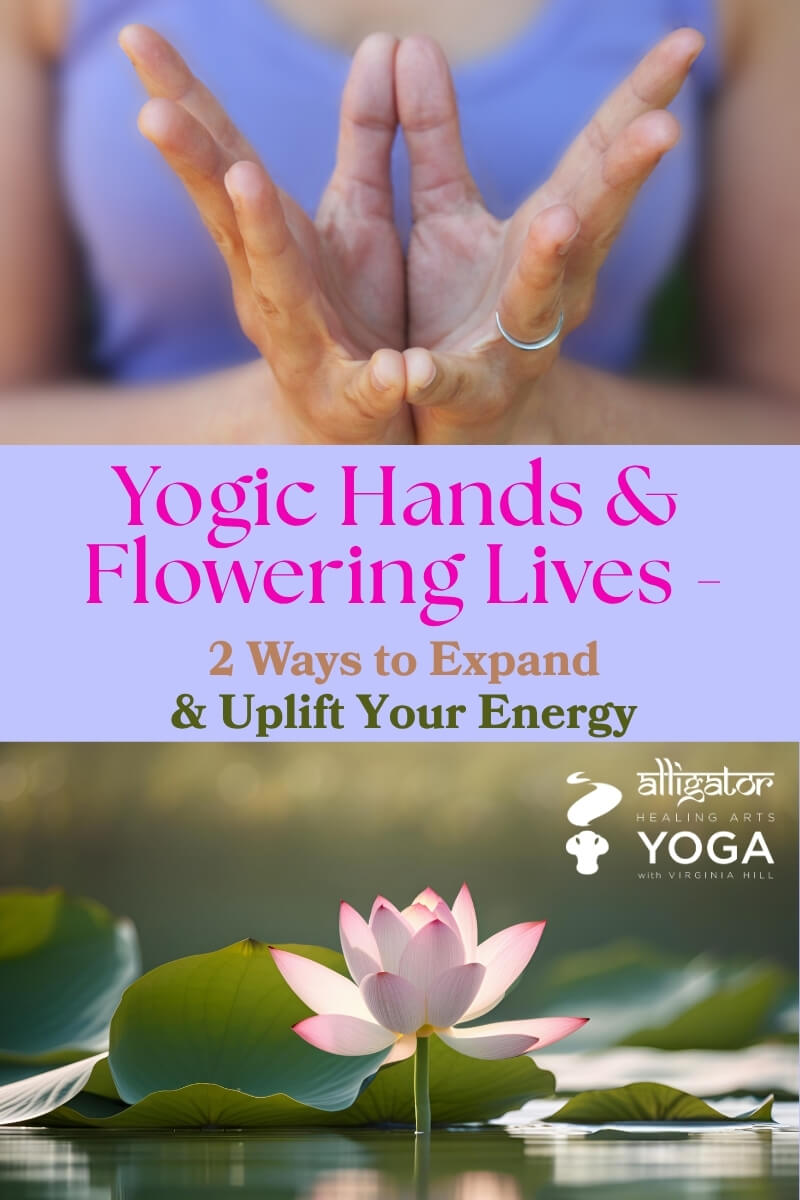
They remained within its very center—on a lotus-petaled seat—drawing nourishment from the mud beneath them, connecting to the abundance of the earth and all that is, to support their layers and layers of unfolding. The lotus, that ancient and lasting symbol of beauty and vitality, rises from decay and darkness, to float on the water and reach into the lightness of air and warmth of the sun. This flowering becomes an ongoing teaching, helping us understand life and see ourselves better too.
*


*
In yogic imagery, the lotus emerges in many forms and stages, for diverse purposes. It appears as the seat upon which divine beings witness and help the world. It is found beneath and around sages in meditation, as well as in the giving hands of devotees. It is used to describe the utmost beauty of eyes, the power of seeing, and of being seen. The lotus finds its place at the heart of sacred offerings, bedecks many an altar, and adorns stupa, temple, and cave entries. It is used to convey the power of awakened chakras, the energy centers that churn and direct the life force. Buddha himself is often portrayed as holding this poignant flower, or seated upon a lotus throne. In many creation stories, the whole world is said to have issued forth from the divine navel as a lotus.
*

India (Madhya Pradesh)
ca. 1st century BCE, red sandstone. Metropolitan Museum of Art (Image in Public Domain)
*
To ponder the lotus is to remember your place in the order of things. The lotus exhibits a way of being rooted in the world and yet simultaneously open to vast possibilities. As a seat, the lotus is not just a place of rest—it represents situatedness: where we are in relation to others; how we orient; the connection between inner and outer, heaven and earth; the ongoing cycles of change; the blossoming of potentials, and how we carry spirituality—true Being—with us as we move through the world.
*

*
Lotuses also have a natural link to hands—
The hands are what carry what lives within us—memory, longing, love, grief—and shape it into action. They build, bless, offer, protect. Hands touch and communicate, harm and heal. Through the hands, the thoughts of the mind are born into the form of matter. Yet the exchange wrought by hands flows in both directions. With awareness, the hands take shape to guide the mind—steadying it, softening it, opening it to insight and calm.
This is the essence of mudrā—a yogic gesture that amplifies nourishing energies, then seals such energy and widens perception. Mudrās are more than symbolic shapes of the fingers; they are tools for focusing a distracted mind, refining awareness, preserving subtle energy, and deepening our connection to the sacred, what truly matters. Among the many gestures passed down through traditional yogic practices, two stand out for the times we’re in:
Saṃputa, a gesture of protection and potentials for the innermost treasure, and
Padma, the hand-held blossoming lotus linking the innermost heart to the love of the world.
One holds and safeguards what is most precious. The other opens with grace toward unity, wisdom, and beauty. Together, they invite us into the quieter layers of the self—those not always visible, but always present. All of us can benefit from using our hands, from bud to blossom.
*
*
Saṃputa Mudrā — The Seal of the Hidden Treasure
In Sanskrit, saṃputa means a sacred container or a vessel that holds something precious. It also means “bud,” as in the bud of the flower that already holds in its envelope all the glory the flower will become. This mudrā is sometimes associated with the dove (kapota), a creature of gentleness, devotion, and hidden flight, that can only be held within the lightest of grips. This hand mudrā uses both hands in a delicate balance, forming a numinous space. It invites us to hold with great tenderness the treasure of the innermost self—the part that is extremely precious yet easily scattered or exposed in contemporary life. Saṃputa Mudrā reminds us to hold with reverence and care what is often ignored, yet what matters most.
*

*
To practice Saṃputa Mudrā:
- Bring your hands together in front of the heart, palms facing one another.
- Cup them slightly, so the fingertips and heels of the hands touch, but the palms remain gently open.
- Imagine holding a small, radiant presence—a baby bird, a glowing ember, or a droplet of nectar—between your hands.
- Let the gesture feel both delicate and unshakeable.
This mudrā is traditionally used in tantric yoga and mantra practices, especially before deep meditation or sacred recitation. It helps gather the mind’s energy inward, balancing all five elements and steadying mental fluctuations. It is especially supportive during periods of grief, transition, or quiet integration.
Practice Suggestions:
- Hold for 5–15 minutes, either seated or reclined.
- Let the breath be slow and even, and direct awareness to the space between the palms.
- Softly gaze at the hands, or close the eyes and rest the gaze inward at the heart.
- A simple affirmation might be:
“I hold what is sacred within me. The treasure of the innermost Self is safe, whole, and alive.”
Benefits of Saṃputa Mudrā:
- Reduces mental restlessness and emotional overwhelm
- Supports inner integration and reflection
- Encourages reverence for one’s own energetic boundaries
- Cultivates subtle awareness and tenderness
- Balances the five tattvas (elements) in Ayurvedic understanding
- Invites the practitioner into contact with their “Original Nature,” as described in traditional teachings
When to Practice Saṃputa Mudrā:
Use this mudrā when you feel scattered, overexposed, or disconnected from your own center. Practice it when something in you feels precious but vulnerable. This mudrā is also useful if you find you have picked up energies that others have thrown upon you. Let this be a way of gently gathering yourself back together. Be sure to note: What do you notice before, during, and after?
*
Padma Mudrā — The Lotus of the Luminous Heart
If Saṃputa teaches us to gather and presenrve, Padma shows us how to open and expand—to truly honor all we are given by savoring the richness of experience and the impermanence of this precious human life. As the lotus moves from bud to blossom, we, too, have much to grow and show in this limited span of a lifetime. Padma Mudrā helps us make the most of it—right here, right now.
Padma, meaning lotus, is a gesture of the blossoming heart. It is a classical mudrā used in both yogic meditative practice and Indian dance traditions. It is also part of the closing cycle of mudrās used in Gāyatrī mantra recitation. Padma is related to a well-known seated yoga posture, known not only for its challenge but also for its lasting stability—so that the mind can go more and more inward and eventually blossom into enlightenment. The crown chakra, Sahasrāra, meaning “thousand-petaled,” refers to the lotus as a symbol of the vastness of spiritual awakening.
In myth and symbol, the lotus is connected to purity—not in the moralistic sense, but as a radiant clarity born of life’s muddy experiences. The flower opens not because it has avoided the mud, but because it has used the mud to ascend, bloom, and expand. Thus the lotus links to a clear, pristine, and one-pointed mind, the refined mind of yogic practice.
*

*
To practice Padma Mudrā:
- Bring your hands together at the heart, palms touching.
- Keep the outer edges of the pinkies and thumbs touching, while opening the other fingers outward like the petals of a flower.
- The base of the hands remains connected, creating a chalice shape.
- Rest the hands lightly against the heart center.
The gaze may rest gently at the center of the flower formed by the palms, or the eyes may close to turn that gaze inward, toward the lotus of the heart. This is a mudrā of offering and devotion—toward the quiet radiance of the innermost self and how it is meant to be, flourish, and shine as an integral part of this world. You, too, can experience the sweetness of your own truest Self, simply by slowing down and quietly attending to the essence of your being.
Practice Suggestions:
- Hold for 5–10 minutes while seated, or during a moment of reflection after physical practice.
- Breathe into the heart center, sensing each inhalation as a gift, each exhalation as a softening.
- Softly gaze into the center of the mudrā, or close the eyes and focus inward on the heart center.
- Suggested affirmation:
“I open to receive what nourishes and give from what is true. I am steady, open, and connected to all of life.”
Benefits of Padma Mudrā:
- Opens the Anāhata Chakra (heart center)
- Softens defenses around the heart
- Encourages emotional clarity and compassion
- Uplifts feelings of loneliness, disconnection, or spiritual dryness
- Strengthens the immune system and supports the heart–pericardium energetic layer
- Awakens spiritual longing and bhakti (devotion) without dogma
When to Practice Padma Mudrā:
Practice Padma Mudrā when your heart feels closed, when you long to reconnect, or when you simply want to remember the beauty of being alive. This mudrā is marvelous for when you’re feeling a little lonely, misunderstood, separate, exploited, or unseen. Let it help you cleanse, soften, and devote yourself—to your gifts, to connection, to the beauty of life, to all you love the most.
*
*
Your Hands Know the Way Back: Study and Practice Beyond the Pose
The beauty of these mudrās lies in their simplicity. You don’t need a mat, a retreat, or a full hour to receive their medicine. They meet you where you are—in the pause before a conversation, the quiet of a morning ritual, or the moment before you sleep. Through your hands, you remember what is of utmost value. You also gain access to your most subtle layers, and expand the capacities of your perception, making life sweeter.
If these practices speak to you, there’s more to explore.
In our upcoming Easy Yoga series, we’ll be learning ten additional mudrās and how to integrate them into our physical (āsana) yoga practice. This is part of our 8-week exploration of the five layers of being—from the physical body to the subtle breath, the mind with its bevy of thoughts and emotions, the wisdom body, and the bliss layer. Mudrās are woven into these teachings as keys to energy, to resilience, to inner connection.
🌟 Come practice with us this season. Rediscover the quiet power already living in your own hands, body, mind, and Being.
*

*

